
NAD has expanded its Classic Series with two new integrated amplifiers that look like they were pulled straight from a 1970s hi-fi rack. The C 3030 and C 3030S take inspiration from the original NAD 3030 released in the late 1970s, complete with illuminated VU meters, a black faceplate, and the cursive NAD logo.
These amplifiers come with HDMI eARC, Bluetooth, and, in the case of the C 3030S, full BluOS streaming built in.
The design
NAD’s Product Manager Morten Nielsen framed these releases around what he calls “a wider shift toward more intentional listening.” The idea is that vinyl and CDs aren’t replacing streaming, but they’re complementing it.
The proportions of both models are closer to the original NAD 3030 than the larger C 3050 anniversary amplifier. This results in a 14-inch-wide chassis (356mm), and at roughly 12 pounds, it’s easy to position wherever you need it.
In the original 3030, the VU meters monitored the output to avoid clipping those early transistor stages. Now, they provide a real-time visual representation of your music’s dynamics. Some find it satisfying, but I just think they look good.
NAD C 3030 overview
The base C 3030 gives you 50 watts per channel of amplification, which the company rates using their Full Disclosure Power method, both channels driven across the full 20Hz to 20kHz frequency range at rated distortion.
Dynamic power tells a more interesting story: 120W into 8 ohms, 250W into 4 ohms, and 390W into 2 ohms. That headroom means the amplifier should handle transient peaks without compression.
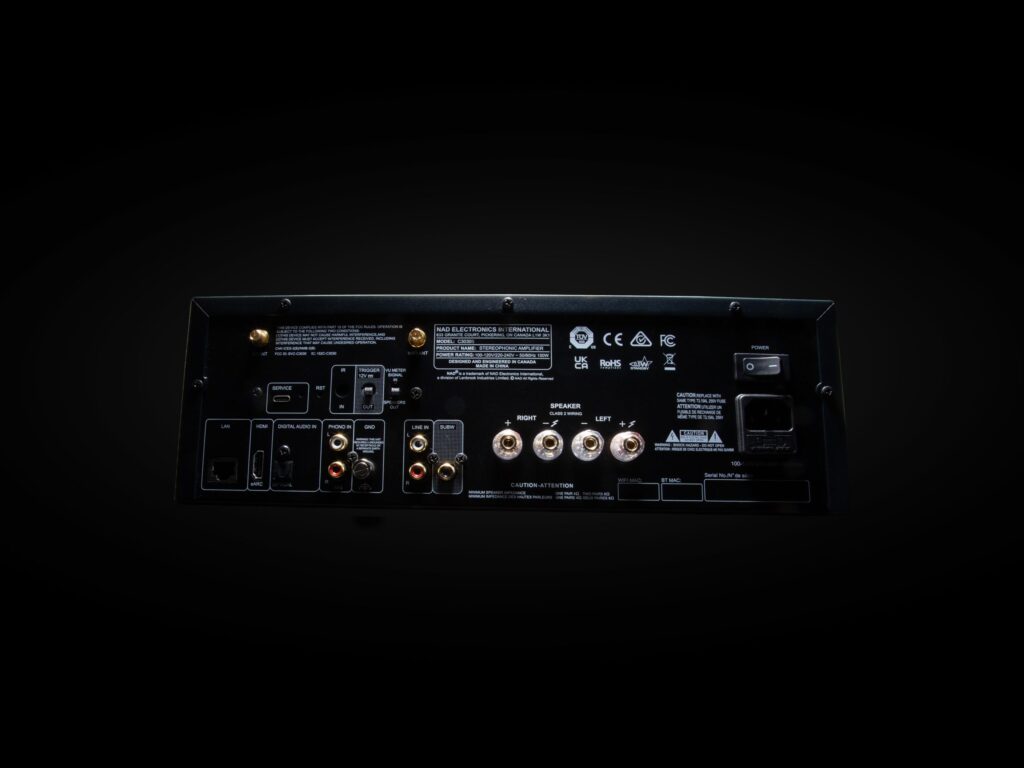
Connectivity includes HDMI eARC for direct TV integration, aptX HD Bluetooth for wireless streaming, one optical input, one line input, and a moving magnet phono stage for vinyl. The bass-managed subwoofer output with an optional 80Hz high-pass filter lets you build a 2.1 system without overworking your main speakers.
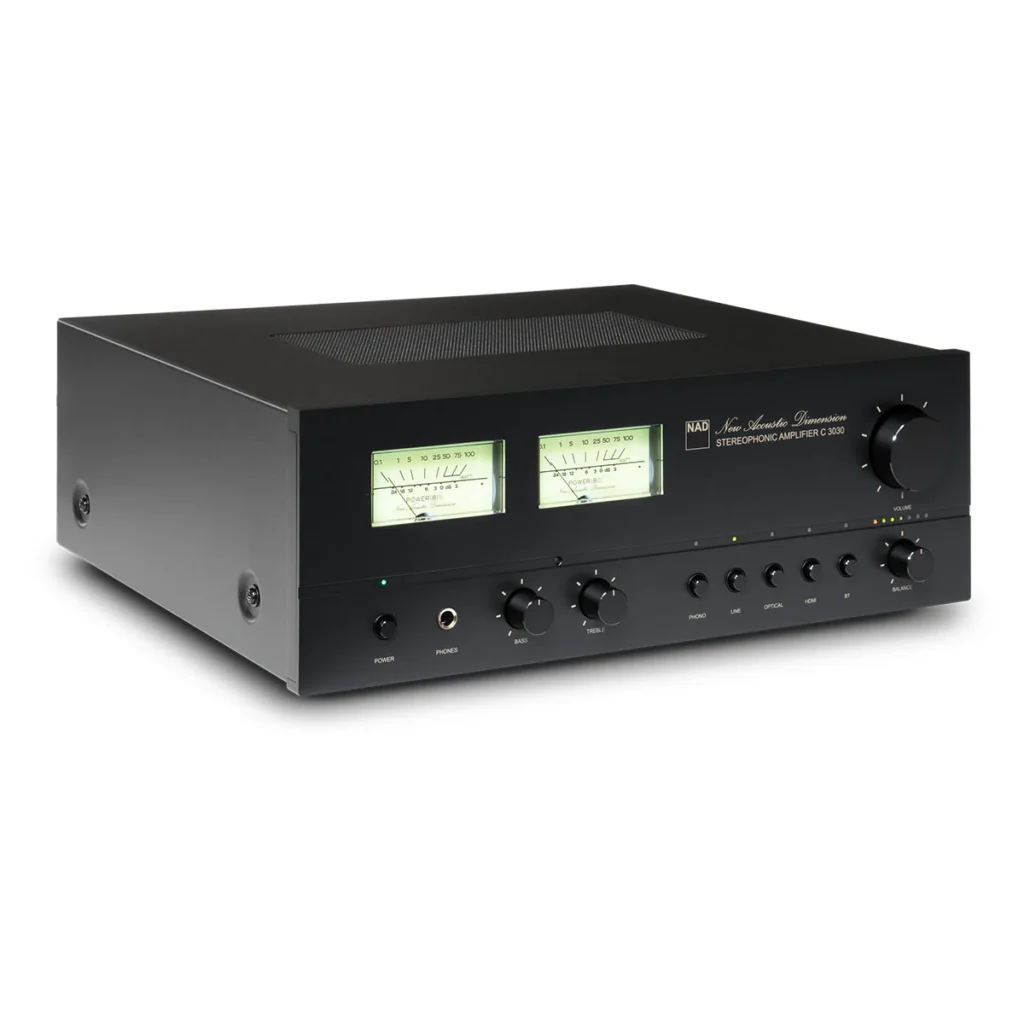
C 3030 Inputs/Outputs:
- 1x Phono input (MM)
- 1x Line input
- 1x Optical input
- 1x HDMI eARC
- Bluetooth (aptX HD)
- Subwoofer output with 80Hz high-pass filter
- Headphone output
- Pre-out
NAD C 3030S: Streaming built-in
The C 3030S shares the same amplifier platform but adds BluOS high-resolution multi-room streaming. This transforms it into a complete music system without needing an external streamer.
BluOS supports lossless playback up to 24-bit/192kHz, native MQA decoding, and access to over 20 streaming services, including Tidal, Qobuz, Spotify, and Amazon Music HD. The BluOS Controller app handles everything from your phone or tablet, and you can group the C 3030S with other BluOS-enabled products for multi-room audio.
The NAD C 3030S model retains all the connectivity of the standard C 3030, HDMI eARC, aptX HD Bluetooth, phono input, optical, and the bass-managed subwoofer output.
C 3030S Additional Features:
- BluOS streaming (Wi-Fi and Ethernet)
- 24-bit/192kHz lossless playback
- Native MQA decoding
- 20+ streaming services
- Multi-room capability
- USB Type-A for local storage
What NAD isn’t telling us
NAD’s press materials describe the C 3030 as delivering “50 watts per channel of powerfully clean NAD amplification” and call it “award-winning amplification engineered for real-world loudspeaker compatibility.”
However, they don’t explicitly state the amplifier topology.
NAD announced several years ago that it had ceased Class A/B development entirely, pivoting to various Class D implementations across its product line. The larger C 3050 uses its HybridDigital UcD architecture.
More details on the HybridDigital UcD architecture can be found here.
But what’s inside the C 3030? The official product pages don’t say. Some dealers have assumed it’s HybridDigital UcD based on the specs, but NAD hasn’t confirmed this. It’s an unusual omission for a company that typically promotes its amplifier technology as a selling point.
Does it matter? Maybe not for most buyers. The specs suggest competent performance regardless of topology.
Specifications
| Spec | C 3030 | C 3030S |
| Continuous Power | 50W x 2 (8Ω and 4Ω) | 50W x 2 (8Ω and 4Ω) |
| Dynamic Power (8Ω) | 120W | 120W |
| Dynamic Power (4Ω) | 250W | 250W |
| Dynamic Power (2Ω) | 390W | 390W |
| THD | <0.03% (250mW–50W) | <0.03% (250mW–50W) |
| SNR | >90dB | >90dB |
| Frequency Response | 20Hz–20kHz (±0.3dB) | 20Hz–20kHz (±0.3dB) |
| Damping Factor | >52 | >52 |
| BluOS Streaming | No | Yes |
| Dimensions (W x H x D) | 356 x 127 x 330mm | 356 x 127 x 330mm |
| Weight | ~5.4kg | ~5.4kg |
Pricing and availability
The NAD C 3030 is available now through authorized NAD retailers at $1,199 USD / $1,299 CAD.
The NAD C 3030S will arrive in Spring 2026 at $1,499 USD / $1,699 CAD.
Our take
The C 3030 and C 3030S are good additions to NAD’s lineup. The compact form factor, design touches, and modern connectivity make them appealing for listeners who want their hi-fi system to look as good as it sounds.
If you already have a preferred streamer or stream primarily through their TV, the standard C 3030 would suit you. If you want an all-in-one solution with BluOS built in, the C 3030S is a good choice as NAD’s most affordable BluOS amplifier to date.
More information is available at NAD.
Related posts:
- Samsung expands 2026 audio lineup with new soundbars and Wi-Fi speakers
- Tribit PocketGo vs JBL Go 4: Which budget speaker delivers better value?
- Tribit Pocket Go brings Bluetooth 6.0 and MicroSD playback to the budget sector
- Connected Fidelity launches CF-1010 9-Inch tonearm
- Sourcepoint V10 Master Edition from MoFi and Andrew Jones